“Please Unite Again,” cried out the United Nations Security Council to Libya. By 2014 it looked as if the discord present in the country since Qaddafi’s rule had no end. Civil warfare between regions, tribes, warlords, and terrorist groups still persists today throughout the torn nation. Across the region towns and tribes are forced to choose sides as two governments and two parliaments continue to fight for power through various militias (Amnesty International 5). At the epicenter of the violence is Benghazi where street battle assassinations and abductions have become common. The effects of the unrest have changed Libyan lives forever with many begging for peace to be restored to their home.
In 2014, the most powerful leader in Libya was former Qaddafi protégé Khalifa Haftar. Haftar dominated the Eastern Region and was the leader of Operation Dignity; a military campaigned warred against the Surah Council of Benghazi Revolutionaries. Islamist nationalists include Salah Badi. Badi is considered an ultraconservative Islamist and is responsible for the shutdown of the Benghazi International Airport.
David Kirkpatrick captured Badi’s attack on the airport in the New York Times article entitled “Strife in Libya Could Presage Long Civil War”:
“’The fire is inside the airport’ a militant cried as he fired an antiaircraft cannon on the back of a pickup truck toward the runway of Libya’s main international airport.”
“’Intensify the shooting’ responded his commander, Salah Badi”
Across Libya flags of rival militias are being flown, some including the black banners signifying support of the Islamist extremism. As noted in the Middle East Policy journal, the main focus of Islamist nationalists is to restore Sharia law. This includes implementing Islamic criminal law, the separation of sexes in public domain, and the extension of the Quranic school system. Opposition to these ideas has become increasingly insignificant as internationally recognized prime minister, Fayez al-Sarraj, exerts very little influence outside of the capital of Tripoli (The Monitor’s Editorial Board).
Libya still continues to struggle 2013
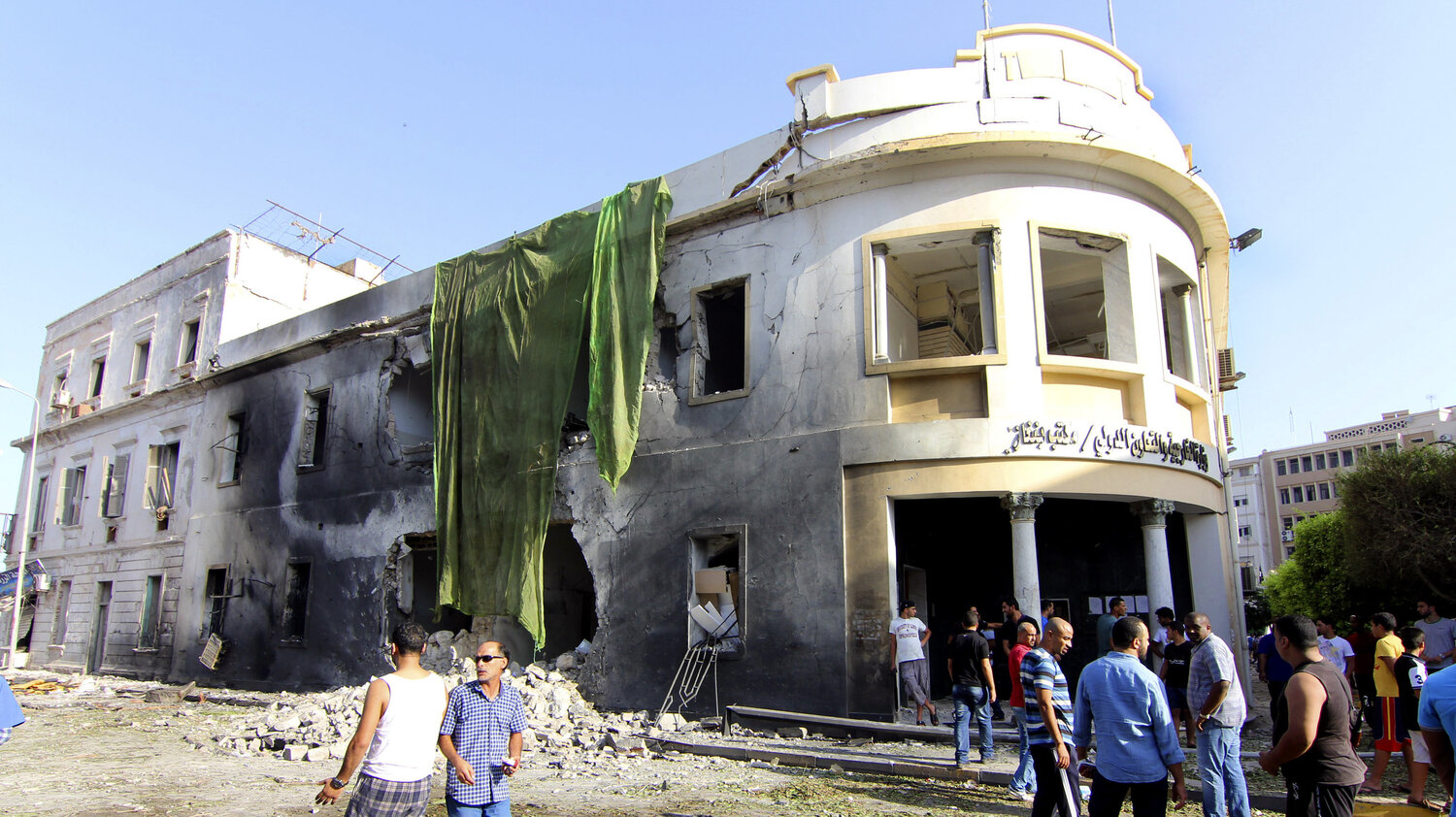
The fight to achieve these goals has transformed Libya into a warzone. David Kirkpatrick wrote, “Constant shelling between rival militias has leveled blocks, emptied neighborhoods and killed hundreds of people. Storage tanks holding about 25 million gallons of fuel have burned unchecked for a month.” Bicycles are the primary mode of transportation as fuel has become rare to find. Trash piles up on the streets, and food prices soar making it hard for many Libyans to have a stable food supply. Many have tried to seek asylum elsewhere as an estimated 90,000 people have fled their homes in Benghazi since 2012 (Amnesty International 6). By the end of 2014, the United Nations and other Western powers unplugged their missions and removed diplomats from the country.

aftermath of civil war in Benghazi
The war has greatly devastated the morale among Libyan people. Nafia Elbouri is a 30-year-old Benghazi resident who spoke to David Kirkpatrick in an interview with the New York Times. He said, “I don’t see anyone smiling. You enter a place and you feel like they would eat you with their eyes. The city we grew up loving is not the one we see today.”
Most recently, the United Nations has revisited the ongoing strife with the proposal of a Listening Tour in Libya. At the head of the tour is Ghassan Salamé, who since August 2017 has been traveling to different cities creating dialogue among Libyans who want to restore a democratic nation-state. In spite of fear resulting from tyrannical regime and tribal warfare, Libyans seek to return to normalcy. While highways and roadways have been shattered, people still roam Dubai Street browsing shops and stopping for drinks at local cafes. Universities have begun holding a small amount of classes off campus. Peace in Libya is on the rise, though it as a long time coming. The United Nations Listening Tour mission states, “the path to statehood, old or new, must come peacefully.”
Amnesty International. (2015). Benghazi’s Descent Into Chaos: Abductions, Summary Killings and Other Abuses. Retrieved from www.amnesty.org/download/Documents/MDE1900012015ENGLISH.PDF
Kirkpatrick, David D. “Strife in Libya Could Presage Long Civil War.” New York Times, 25 Aug. 2014, pp. A1-A3. EBSCOhost.
Mattes, Hanspeter. “Libya since 2011: Political Transformation and Violence.” Middle East Policy, vol. 23, no. 2, Summer 2016, pp. 59-75. EBSCOhost, doi:10.1111/mepo.12195.
The Monitor’s Editorial Board. “The UN’s Listening Tour in Libya.” Christian Science Monitor, 04 Aug. 2017. EBSCOhost.
